
B2B eCommerce Case Study
Elevating B2B to Consumer Standards


AI Prototype - Case Study
B2B eCommerce
This interactive prototype expands on the foundational CPQ (Configure, Price, Quote) work I led at Apttus. I focused on guiding our team to design a modern, flexible eCommerce experience with a consumer-grade feel, fundamentally streamlining B2B procurement. The solution empowers users to complete most tasks independently, while offering easy access to expert support for complex or bulk configurations. The result is a highly innovative, feature-rich platform that sets a new industry benchmark and outpaces current market standards.
Some of the highlighted features:
- Faceted filters
- Interactive comparison grids featuring built-in toggles to highlight key similarities and differences
- Custom product configurations
- Pinnable Cart
- Multi-destination cart distribution, giving users the power to split a single order across different delivery endpoints.
- Designed a unified "Request Quote" and configuration assistant workflow to guide users through complex order procurement.
- Dynamic cart-totaling framework that calculates full order values live, seamlessly aggregating product and service costs, shipping, and taxes while automatically applying bulk discounts and promotional codes.
What I would add or do different:
- I would use AI to help users find and configure products
- I would add an option for product configuration help, both through AI and human connection
- I would add the ability to save a cart for reorder/repurchase
- I would add the ability save products to favorites, create wish list, etc.
- Use the cart to execute a purchase on CPQ quotes
- Make it easier to use current location to set up additional distribution points.
- Make subscription purchase/management more front and center.
Based on Needs gathering Research
The Personas And Their Needs
User Research
Clair
The CFO
Primary Role
Subscription Management
Responsibility
As a financial manager, there is a critical need to gain oversight of the digital ecosystem. The struggle centered on visibility and utilization.
Direct Quotes
objectives
01
Identify all applications currently being expensed.
02
Track renewal terms and upcoming expirations.
03
Monitor real utilization to identify shelved assets.
Chris
The CIO
Primary Role
Policy Management &
Governance
Responsibility
The CIO's primary focus was security. Governance requires granular control over how subscriptions are distributed and who can access specific environments.
Direct Quotes
objectives
01
Instant onboarding/offboarding processes.
02
Distribution logic based on company, org, or role.
03
IP protection through environment monitoring.
Tom
The CTO
Primary Role
Cloud Migration
Responsibility
For the CTO, operational efficiency was the pivot. The goal was to "cloudify" internal systems and reduce time-to-market for new infrastructure.
Direct Quotes
objectives
01
Accelerate environment firing from weeks to minutes.
02
Maximize utilization to prevent system overspending.
03
Dynamic resource reallocation to meet real-time demand.
User Research
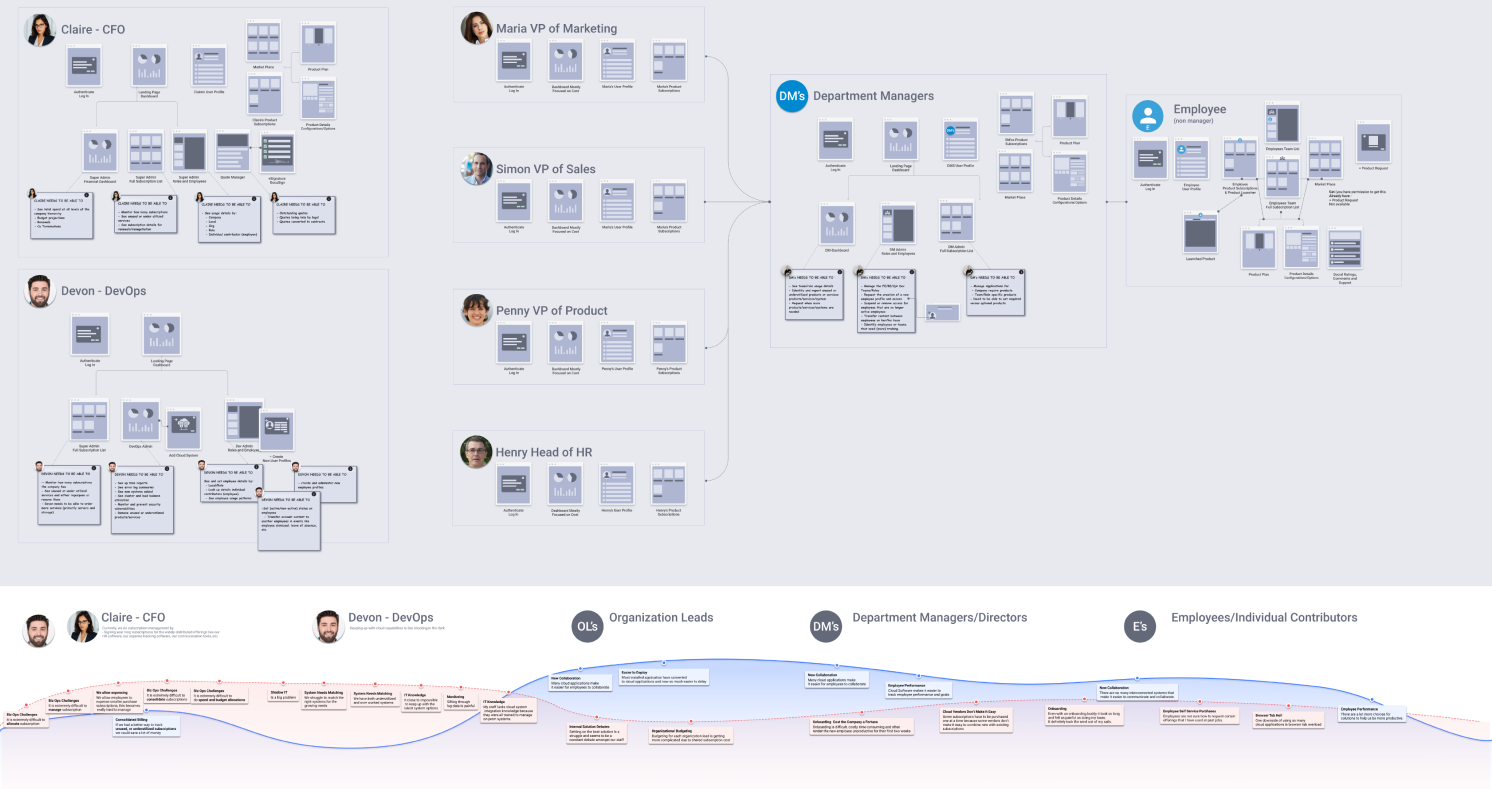
Journey and Empathy Mapping
Every project begins with a set of hypotheses, but turning those assumptions into insight requires mapping the actual user experience. These empathy and journey maps allowed us to visualize the user's path, deeply understand their struggles, and validate their true needs.
My Ownership in this project
As Head of Product Design, UX, and Strategy
My team and I owned ....

Strategy & Vision
Information Architecture
User Research & Validation
Journey Mapping
High-Fidelity Prototyping
Design System Integration
Customer Interviews/Validation
Competitive Analysis
Design Presentation and Investor Pitch
Custumer Quote
“Something about the app”
Reflection
What We Learned
What Could Be Better
Mobile experience was de-prioritized due to timeline constraints. While the responsive web experience works, a native mobile app remained on the roadmap.
What Went Well
Early and continuous validation with enterprise customers offered solid proof for the need, and it helped us prevent pivots. The journey mapping exercise proved invaluable] by creating alignment across product, design, and engineering, and became a living document we referenced throughout development.
Key Learnings
Our most costly mistake was skipping an initial competitive analysis. We focused heavily on validating user needs and solutions, which caused us to overlook the fourteen other companies already operating in this space.
We possessed the vision to deliver a far more complete and superior offering. However, a field of fourteen active competitors proved to be an immediate blocker for most of the venture capitalists we were engaging with.
We possessed the vision to deliver a far more complete and superior offering. However, a field of fourteen active competitors proved to be an immediate blocker for most of the venture capitalists we were engaging with.
The Punchline
Corderum made the tough decision to no longer pursue the subscription management and the cloud migration offerings and instead focused on assisting one of our partners Blulogix with their platform needs. While it was not the outcome that I would have preffered, it was an incredible learning experience.
Christian Baptiste
© 2026 Christian Baptiste Portfolio Showcase
